Brewing Gunpowder Tea: Moroccan Mint vs Western Style
Walk into a riad in Marrakech at dusk, and you will be greeted not by a handshake but by the sound of tea pouring from a silver pot into a small decorated glass — a thin golden stream arcing through the air from a height of nearly half a meter. Walk into a minimalist kitchen in Portland or Berlin, and you will find the same gunpowder green tea leaves measured with a digital scale into a glass gaiwan, water heated to precisely 80°C. Same tea. Radically different rituals.
Gunpowder tea — named for its tightly rolled pellets that resemble grains of gunpowder — is one of China’s most iconic green tea exports. Produced primarily in Zhejiang province, these small, shiny dark-green pearls have been the backbone of North African tea culture for centuries and, more recently, have found a growing audience among Western specialty tea drinkers. But the way you brew it changes everything.
This guide walks you through both traditions step by step, compares their flavor outcomes, and explains why understanding both methods matters whether you are a casual drinker or a professional buyer sourcing wholesale gunpowder tea for international markets.
What Makes Gunpowder Tea Different
Before comparing methods, it helps to understand what sets gunpowder tea apart from other green teas. Unlike the flat, needle-shaped leaves of Dragon Well (Longjing) or the twisted leaves of Chunmee tea, gunpowder tea leaves are rolled into tight, spherical pellets during processing. This rolling technique serves three purposes: it protects the leaves from physical damage during shipping, it slows oxidation to preserve freshness over long periods, and it produces a distinctively bold, slightly smoky flavor when brewed.
The production of gunpowder tea follows a precise sequence: withering, fixation(Halt fermentation) ,pan-firing, rolling into pellets, and final drying. The pellet size is graded from smallest (highest quality) to largest, with common export grades including 3505AAA, 9501,9374, 9475, 9575 and 9675. Smaller pellets generally indicate younger leaves and a smoother, more complex cup. Larger pellets come from more mature leaves and produce a stronger, more assertive brew.
This robustness is precisely why gunpowder tea became the tea of choice for Moroccan households. It withstands the long journey from Chinese ports to Casablanca, it holds its character under the intense heat of multiple infusions, and its boldness can stand up to generous amounts of sugar and fresh mint — two ingredients that would overpower most delicate green teas.
The Moroccan Mint Tea Ceremony: Atay
A Ritual of Hospitality
In Morocco, tea is not a beverage — it is an institution. Known as atay in Darija (Moroccan Arabic) and sometimes affectionately called whiskey berbère (Berber whiskey), Moroccan mint tea is served multiple times a day in homes, shops, and offices. It is a fundamental expression of welcome: refusing a cup, especially on the first offer, is considered impolite. The ceremony itself — from preparation to the final sip — can last anywhere from 30 minutes to over an hour.
The ritual is traditionally performed by the head of the household, often male, and the act of preparing tea in front of guests is a sign of respect and openness. Every gesture carries meaning: the rinsing of the tea leaves, the dramatic high pour, the careful arrangement of mint in the pot.
Ingredients
| Ingredient | Amount | Notes |
|---|---|---|
| Gunpowder green tea | 2-3 teaspoons | Higher-quality pellets (3505AAA or equivalent) preferred |
| Fresh spearmint (na’na’) | A generous handful | Stems included; spearmint, not peppermint |
| Sugar | 3-6 sugar cubes or equivalent | Traditionally quite sweet; adjustable to taste |
| Boiling water | ~500-750ml | Unlike Western brewing, boiling water is used here |
Some Moroccan households also add other aromatic herbs — verbena, wormwood (sheba), or geranium — in winter months, or orange blossom water for special occasions. But the classic triumvirate is gunpowder tea, spearmint, and sugar.
Step-by-Step Brewing Method
Step 1: Rinse the tea. Place the gunpowder tea pellets directly into the teapot. Pour a small amount of boiling water over them, swirl for 10-15 seconds, and discard this first water. This “awakening” rinse removes any dust, opens the pellets slightly, and reduces bitterness. Some Moroccans call this the “soul” of the tea being washed.
Step 2: First infusion. Add boiling water to the pot — typically filling it about two-thirds full. Let the tea steep for 2-3 minutes on its own, without the mint. This builds a strong, slightly bitter base that will later be balanced by sugar and mint.
Step 3: Add the mint and sugar. Pack the fresh spearmint into the pot — stems and all, often enough to fill the remaining space. Add the sugar directly into the pot (not into individual glasses). Some families pour off a glass of the brewed tea, dissolve the sugar in it, then pour it back into the pot for even distribution.
Step 4: The pour — rghwa. This is the defining move of the Moroccan tea ceremony. The tea is poured from a height — sometimes 30-50 centimeters above the glass — into small decorated glasses. The purpose is twofold: to aerate the tea and to create a layer of foam on the surface called rghwa. A good foam is considered a mark of a well-made tea.
Step 5: Multiple rounds. The same tea leaves and mint are infused three times. Between each round, more sugar and sometimes fresh mint are added. The first round is the lightest; the second is medium; the third is the strongest and most bitter. A Moroccan proverb captures this progression: “The first glass is as gentle as life, the second as strong as love, the third as bitter as death.”
The result is a tea that is intensely sweet, powerfully minty, and underpinned by the smoky, vegetal depth of gunpowder tea. It is drunk hot, even in the scorching Moroccan summer — the combination of hot liquid and mint actually has a cooling effect on the body.
The Western Specialty Tea Approach
Precision and Purity
Where the Moroccan method is about ritual and generosity, the Western approach to brewing gunpowder tea is about precision and flavor isolation. Specialty tea drinkers in Europe, North America, and Australia treat gunpowder tea as a nuanced green tea to be appreciated for its own character — without sugar, without mint, and with careful attention to water temperature, steeping time, and leaf-to-water ratio.
This is partly a function of the specialty coffee and tea movement that has swept Western countries over the past two decades, and partly a reflection of different culinary cultures. Western palates, particularly in Northern Europe and the Anglosphere, tend to be less sugar-forward than North African palates. Drinking tea unsweetened allows the taster to detect the subtle variations between different grades of gunpowder tea — something that matters a great deal when you are a China green tea exporter competing on quality rather than just price.
Ingredients
| Ingredient | Amount | Notes |
|---|---|---|
| Gunpowder green tea | 1 teaspoon (~2g) per 8oz / 240ml water | Adjust to taste; higher-grade teas may use less |
| Water | 240ml per serving | Filtered or spring water preferred |
| Temperature | 75-80°C (167-176°F) | Below boiling — boiling water makes gunpowder bitter |
| Steep time | 2-3 minutes | Start at 2 min; extend for stronger cups |
Optional Western additions include a slice of lemon, a few fresh mint leaves (borrowed from the Moroccan tradition but used far more sparingly), or a teaspoon of honey for those who prefer a touch of sweetness. Iced gunpowder tea with citrus is also a popular summer variation in the United States.
Step-by-Step Brewing Method
Step 1: Measure and heat water. Bring filtered water to 75-80°C. If you do not have a temperature-controlled kettle, bring water to a boil and let it cool for 2-3 minutes. Water that is too hot (near boiling) scorches the delicate catechins in green tea, releasing excessive tannins and bitterness.
Step 2: Rinse the leaves (optional but recommended). Place the gunpowder tea pellets in your teapot, gaiwan, or infuser. Pour a small amount of hot water over them, swirl for 5-10 seconds, and discard. This step awakens the tightly rolled pellets, removes surface dust, and primes the leaves for a cleaner, sweeter extraction. Many professional tea buyers use this step when evaluating samples of wholesale gunpowder tea for quality assessment.
Step 3: First infusion. Pour the hot water over the rinsed pellets and steep for 2 minutes. Watch the pellets unfurl — one of the quiet pleasures of brewing gunpowder tea is observing these tiny green pearls expand into full, intact leaves. A good gunpowder tea will reveal whole leaves, not fragments.
Step 4: Decant and taste. Pour the tea into your cup through a strainer. Do not leave the leaves sitting in water between infusions, as this leads to over-extraction and astringency. Taste the first infusion clean — no additions — to assess the tea’s natural character: vegetal notes, a hint of smokiness, a clean finish with mild astringency.
Step 5: Subsequent infusions. Unlike the Moroccan method where sugar and mint intensify across rounds, the Western approach to multiple infusions reveals a gentler evolution. The second infusion (2.5 minutes) often produces a rounder, sweeter cup as the pellets fully open. The third infusion (3-3.5 minutes) brings out deeper toasted notes. Beyond three infusions, the tea will become noticeably thinner, though high-grade gunpowder teas can sometimes yield four or five brews.
Head-to-Head Comparison
| Dimension | Moroccan Mint Style | Western Specialty Style |
|---|---|---|
| Water temperature | Boiling (~100°C) | 75-80°C |
| Tea-to-water ratio | 2-3 tsp per 500ml | 1 tsp per 240ml |
| Steep time (first infusion) | 2-3 minutes | 2 minutes |
| Additions | Generous mint + sugar | None (or minimal lemon/honey) |
| Number of infusions | 3 (fixed ritual) | 3-5 (depending on grade) |
| Flavor profile | Sweet, minty, robust, smoky base | Vegetal, slightly smoky, clean, mild bitterness |
| Drinking context | Social, ceremonial, family | Personal, contemplative, analytical |
| Glassware | Small decorated tea glasses | Ceramic cup, glass mug, or gaiwan |
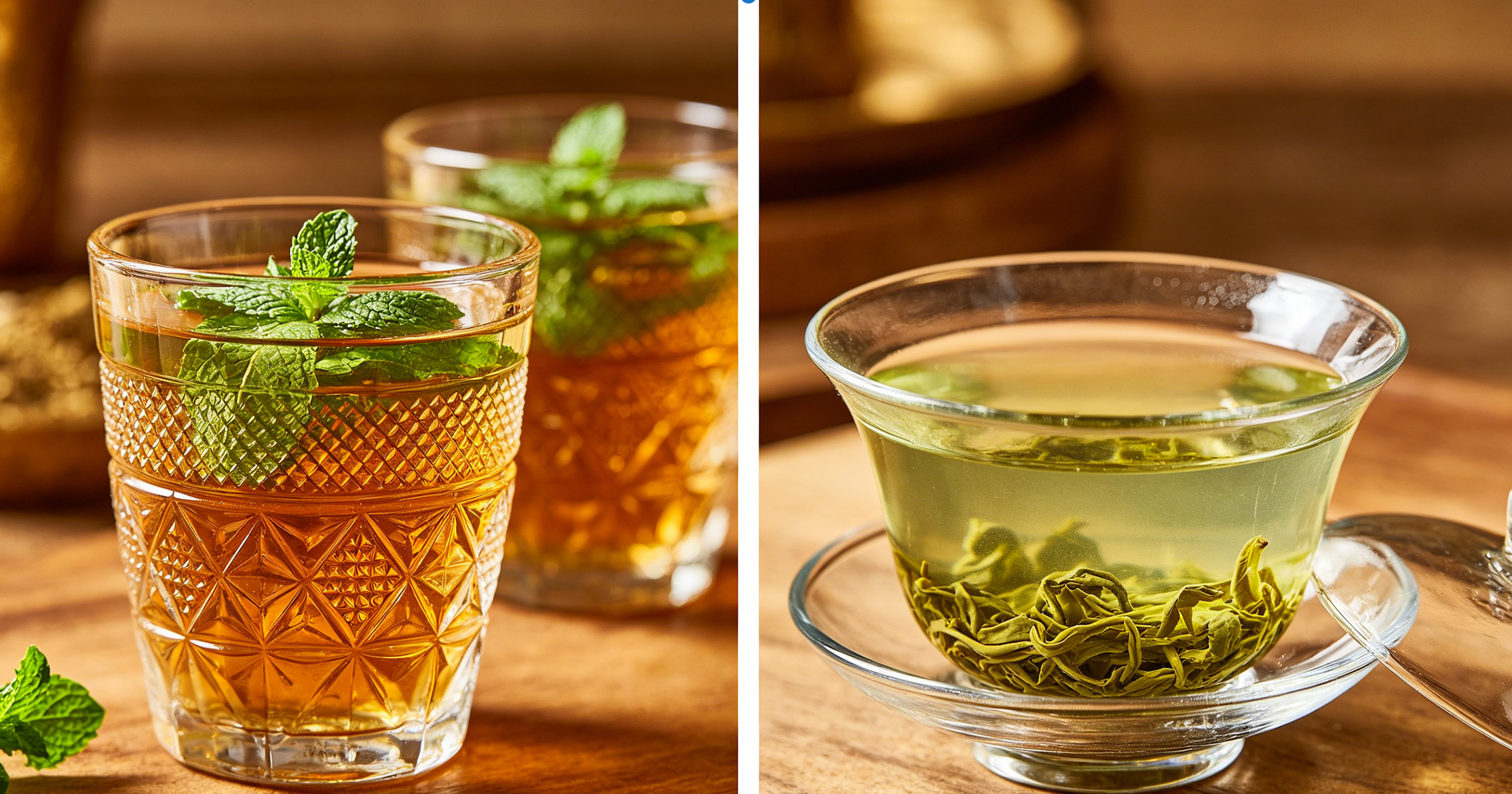
Neither method is “correct” or “incorrect” — they serve different purposes and different palates. The Moroccan method maximizes hospitality and social bonding. The Western method maximizes flavor appreciation and individual experience. Together, they demonstrate the remarkable versatility of the same base ingredient.
What This Means for Tea Buyers and Importers
If you are sourcing gunpowder tea for commercial purposes — whether as a wholesale gunpowder tea importer, a café owner, or a retail brand developer — understanding these two brewing traditions is not just cultural trivia. It has practical implications for which grades you buy, how you package them, and how you market them.
For North African and Middle Eastern markets: Buyers typically seek high to medium pellet grades (3505, 9375) that deliver strong, assertive brews capable of standing up to generous sugar and mint. They value consistency and strength over delicate flavor notes. Packaging is often bulk, 20kg to 25kg cartons — and price sensitivity is high, as tea is a daily staple consumed in large quantities.
For European and North American specialty markets: Buyers gravitate toward smaller pellet grades (3505AAA, 3505) that offer smoother, more complex flavor profiles suited to unsweetened drinking. Organic certification, origin traceability, and attractive retail packaging are critical selling points. These buyers are often also interested in Chunmee tea alongside gunpowder, as the two Chinese green teas complement each other in a well-rounded specialty tea catalog.
For Asian markets (Central Asia): Gunpowder tea occupies a middle ground — often consumed plain or with minimal sugar, and valued for both daily drinking and as a base for blends. Uzbekistan, for example, has been a fast-growing market for Chinese green tea exports in recent years.
Regardless of which market you target, the quality of your supply chain matters. At Ruixing Tea, we have spent years building direct relationships with tea gardens and Maocha factories across Zhejiang, Anhui, Jiangxi, Hubei provinces, ensuring consistent grade quality, reliable logistics, and full compliance with international food safety standards. As a dedicated China green tea manufacturer and exporter, we understand that a tea buyer’s success depends not just on the product in the bag, but on the knowledge and support behind every shipment.
Brewing Method by Purpose: A Quick Decision Guide
| If you want to… | Use this method |
|---|---|
| Impress guests with ceremony | Moroccan mint tea, full ritual with high pour |
| Taste-test a new shipment | Western method, clean, 80°C, no additions |
| Pair with spicy food | Moroccan mint tea — sweetness cuts heat |
| Pair with a light meal or pastry | Western method — subtle tea, subtle food |
| Drink tea all afternoon | Western multiple infusion method (no sugar crash) |
| Share tea in a large group | Moroccan method — one pot serves many |
| Evaluate grade quality for purchasing | Western method at 80°C, first infusion, no additions |
The beauty of gunpowder tea lies precisely in this duality. The same tightly rolled green pellets that travel from Zhejiang to Casablanca can produce an intensely sweet communal ritual or a quiet contemplative cup — depending entirely on the hands that brew it. Whether you reach for the mint and sugar or the digital thermometer, you are participating in a tradition that connects tea drinkers across continents, centuries, and cultures.
For importers, distributors, and retailers looking to source authentic Chinese gunpowder tea — whether for North African bulk markets or Western specialty shelves — Ruixing Tea provides a reliable, quality-assured supply chain from origin to destination. Our team understands both the traditions that shape demand and the standards that define quality. Contact us to discuss your sourcing needs.
Recent Posts
-

-
-
-
-