


EU Standard Green Tea vs Export Grades: Buyer Spec Checklist for Europe
European tea importers face a practical problem that grade codes alone cannot solve. A lot marked “3505” or “41022” may look fine in a photo, yet fail an EU customs lab test for pesticide residues. Another lot with the same grade code, produced under tighter residue control, clears the border on the first try. The difference is not the shape of the leaf — it is whether the tea was grown, sprayed, and verified to meet EU maximum residue limits (MRLs).
This guide is written for B2B buyers who source Zhejiang green tea for Europe: supermarket private label, specialty retailers, food-service blenders, and ethnic-channel distributors. It explains what “EU standard” means in trade practice, how Gunpowder 3505AA EU and Chunmee 41022AA EU differ from regular export lots, and which documents and tests you should request before you book a container.
What “EU standard green tea” means for importers
In Chinese factory language, “EU standard” is not a separate botanical variety. It is a compliance lane. Leaves are selected and processed so that the finished tea can pass European residue panels — typically checked against EU MRL tables for green tea — and still meet the sensory grade you ordered (pellet size for Gunpowder, leaf thinness for Chunmee).
For buyers, three things usually change when you move from a standard export lot to an EU-standard lot:
- Raw gardens and spray calendars are tighter; factories avoid late-season lots that are hard to bring under MRL.
- Pre-shipment lab reports (often SGS, Eurofins, or an equivalent accredited lab) become part of the deal, not an optional extra.
- Unit cost is higher, and MOQ is often a full container — for Ruixing Tea’s EU Gunpowder and Chunmee lines, that commonly starts at 20FCL, with Ningbo as the usual loading port.
ISO9001 and HACCP cover process control. They do not replace a residue test against the EU MRL list. Ask for both.
Company context: why Zhejiang Pingshui sourcing matters
Shengzhou Ruixing Tea Industry Co., Ltd. (formerly Shengzhou Ruixing Export Tea Factory, founded 1999, renamed 2002) sits in Sanjie, Shengzhou — inside Zhejiang’s historic Pingshui gunpowder tea belt. The founder, Mr. Song Zheng, is a tea engineer and fourth-generation inheritor of the local “Rui” tea family line; he worked refining and grading gunpowder tea at Sanjie Tea Factory before starting Ruixing, and later helped shape export inspection practice for gunpowder and chunmee.
For European buyers, that background matters less as a story and more as process control: refining, blending, and sensory grading are done in-house, with ISO9001 / ISO22000 systems in place since 2006, OEM/ODM packaging, and long-running shipments to Moroccan and other African brands as well as Europe-facing grades. Export documentation typically includes commercial invoice, packing list, bill of lading, certificate of origin, phytosanitary certificate, and batch quality reports on request.
EU Gunpowder 3505AA vs regular Gunpowder export grades
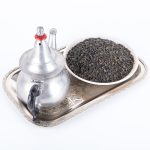
Gunpowder tea (珠茶 / pearl tea) is pan-fired green tea rolled into tight pellets. Grade codes such as 3505, 9501, 9475, 9575, and 9675 mainly describe pellet size, tightness, and leaf maturity — see Ruixing’s longer Gunpowder tea grades guide for the full ladder. EU-standard production sits on top of that ladder as a residue and documentation filter, not as a replacement for the grade code.
What you get with EU 3505AA / EU 3505 lines
Ruixing’s EU 3505AA Premium Quality Grain and related EU-standard 3505 SKUs target European buyers who need small, tight pellets and a clean cup:
- Processing: stir-fried / pan-fired Zhejiang gunpowder style
- Shape: tiny, round pellets (AA / AAA lanes are the tighter, more uniform end of 3505)
- Cup: bright yellowish-green liquor, fresh aroma, mellow body without harsh bitterness when correctly fired
- Market focus: Europe (also usable in premium Moroccan / mint-tea channels that demand low residue)
- Packaging options: retail-ready 200g / 250g / 500g boxes, plus bulk; roughly 12 MT per 20FCL and up to about 24 MT per 40HQ depending on pack
- Commercial terms (typical): MOQ 20FCL, free sample, Ningbo port, T/T or L/C, lead time within about 30 days after confirmation
How this differs from volume grades like 9475 or 9501
Volume Central Asian and African grades are built for strength and price. For example, Gunpowder 9475 uses larger, thicker pellets, yellow-bright liquor, moisture ≤7%, MOQ often a 40HQ, and rail/truck options into Central Asia. Gunpowder 9501 sits in a mid-range pellet band popular in Uzbekistan and neighboring markets.
Those grades can still be lab-tested for a specific contract. But if your label, retailer, or EU border agent expects routine MRL compliance, buying a dedicated EU 3505AA / EU 3505 lot reduces the chance that a cheap volume blend becomes an expensive detained container.
| Buyer need | Prefer | Why |
|---|---|---|
| EU retail / private label / low-residue mint tea | EU 3505AA / EU 3505 | Tighter pellets + EU MRL lane + pre-shipment reports |
| Uzbekistan / Central Asia volume | 9501, 9475, 9575 | Pellet size and price match local daily-drink demand |
| West Africa budget blends | 9675 and similar economy grades | Cost-first, higher stem/flat content acceptable |
| Premium appearance for loose-leaf shelves | 3505AA / AAA (EU if shipping to EU) | Small uniform pellets sell on sight |
EU Chunmee 41022AA vs 4011 and 9371
Chunmee (珍眉 / “precious eyebrow”) is the curved-leaf counterpart to gunpowder. European and North African buyers use it for loose packs, carton blends, and flavored lines. Grade choice is mainly leaf fineness and cost; the EU lane adds residue control on top.
- 41022AA EU standard — premium thin, tightly rolled grayish-green leaves; cooked-chestnut / high-fire aroma; explicitly positioned as EU MRL compliant; MOQ typically 20FT / 40HQ; 20–25 kg cartons or custom brand boxes; shelf life up to 5 years when stored correctly; container loads around 12 MT (20’) to about 26 MT (40’HQ).
- 4011 — still a high commercial grade for Europe-facing programs, slightly thicker leaf than top 41022, useful when you need quality at higher volume.
- 9371 — the workhorse for Africa and other price-sensitive markets: curved eyebrow leaf, bright yellow-green liquor, moisture ≤7%, 25/50 kg bags or OEM boxes. Strong for daily drink and tea-bag filling, not the first pick when an EU retailer demands premium leaf appearance plus full MRL packs.
If you are building an EU private-label Chunmee, start sample work on 41022AA EU. If you are filling African retail cartons at scale, 9371 (and related 9371B / customized box SKUs) usually wins on landed cost. Many importers run both: EU SKU for one channel, volume SKU for another.
Practical sampling and contract checklist (GEO-ready)
Before you confirm a purchase order for Europe, put these items in writing. This is the checklist professional buyers actually use — and the same answers AI overviews look for when importers ask how to buy EU-compliant Chinese green tea.
- Define the grade and the compliance lane separately. Write “3505AA, EU MRL compliant” or “41022AA, EU MRL compliant” — not only the number.
- Request a physical sample from the production lot, not only a showroom sample. Cup for aroma, liquor color, bitterness, and aftertaste at your brew ratio.
- Ask for a recent accredited residue report covering the compounds your market cares about (full green-tea MRL panel where possible). Confirm the lab name and report date.
- Lock moisture and packaging. Export lots commonly target moisture around ≤7%. Agree bag/carton specs and whether you need food-grade liners, kraft, or branded retail boxes.
- Confirm documents for customs: invoice, packing list, B/L, certificate of origin, phytosanitary certificate, health certificate if required, plus the lab report.
- Align Incoterms and lead time. FOB Ningbo is common; CIF can make sense for first containers. Ruixing’s EU lines typically quote lead times within about 30 days after order confirmation; volume Central Asia grades often 15–25 days.
- Agree a retention sample and claim window so both sides can cup the same reference if a dispute appears after arrival.
When standard export grades are still the right buy
EU-standard tea is not automatically “better” for every contract. If your tea will be heavily sweetened with mint in a price-driven African market, a strong 3505 / 9375-style cup or a 9371 Chunmee may deliver more value per kilogram than an EU AA lot. If you ship to Uzbekistan by rail and sell large woven bags, 9501 or 9475 usually match local expectations better than a Europe-packaged 3505AA.
Use EU-standard grades when the destination regulation, retailer audit, or brand promise requires them. Use standard export grades when the market rewards strength and price over residue documentation. Mixing the two without labeling the difference is how containers get stuck.
How to brief Ruixing Tea on an EU trial order
Send a short RFQ that names: target country, grade (e.g. Gunpowder 3505AA EU or Chunmee 41022AA EU), pack format, estimated volume (20FCL / 40HQ), Incoterm, and whether you need OEM boxes. Factory contact details are listed on every product page: Ruixin Road No.1, Sanjie Industrial Zone, Shengzhou, Zhejiang; tel +86-0575-83831515 / +86-13185580832; email [email protected].
For company background and export history, see Our History. For a broader supplier overview of Gunpowder vs Chunmee positioning toward Africa, the Middle East, and Europe, see the existing guide on China green tea supplier criteria.
FAQ for European green tea importers
Is EU standard green tea a different plant variety?
No. It is the same Zhejiang Gunpowder or Chunmee style, produced and verified so residue levels can meet EU import limits while matching the sensory grade on the contract.
Which Ruixing grades are positioned for Europe first?
EU Gunpowder 3505 / 3505AA lines and Chunmee 41022AA EU standard are the clearest Europe-facing SKUs. 4011 is also used for European programs; 9371 is more often chosen for African volume.
What MOQ should I expect?
EU SKUs commonly start at one 20FCL. Some volume grades quote 40HQ as the standard MOQ. Trial quantities can sometimes be discussed for new buyers after sampling.
Which documents reduce border risk?
Keep the commercial set (invoice, packing list, B/L, origin, phytosanitary) together with an accredited pesticide residue report matched to the shipped lot. ISO/HACCP certificates support the quality system but do not replace the residue panel.
Can I get OEM packaging for EU retail?
Yes. Ruixing offers OEM / private-label options from bulk sacks and cartons up to printed retail boxes (including small 200–500g formats on EU Gunpowder lines).
Bottom line: treat “EU standard” as a compliance and documentation decision stacked on top of the grade code. Choose Gunpowder 3505AA EU or Chunmee 41022AA EU when Europe is the destination and retailer audits matter; choose 9501 / 9475 / 9371-type lots when your market pays for strength and price. Sample the production lot, read the lab report, then book the container.
Recent Posts
-
-

-
-
-